Data centers and communications networks support the digital services global economies rely on. Cloud computing and artificial intelligence (AI) enable new applications while increasing infrastructure complexity and interdependence. A single vulnerability or malfunction can affect the reliability of connected networks and services worldwide.
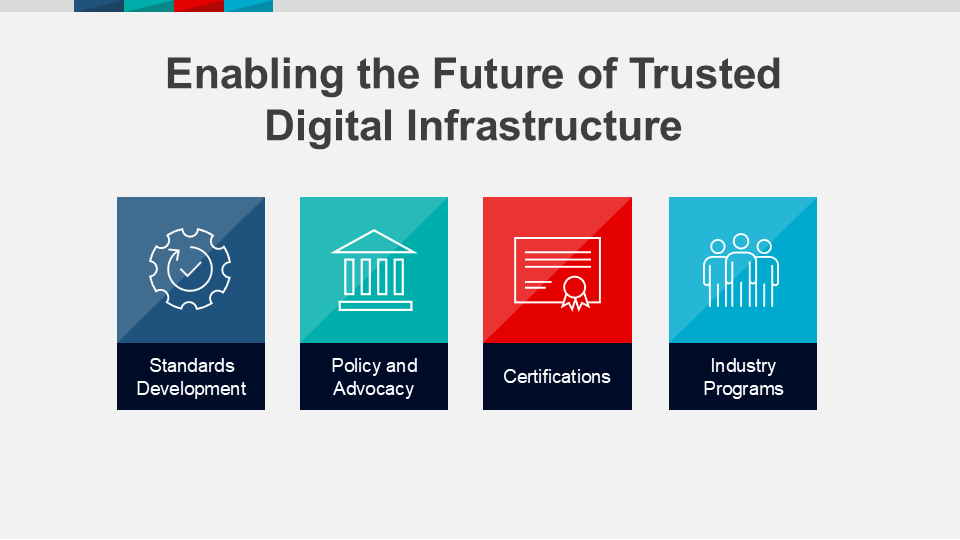
To address these challenges, the Telecommunications Industry Association (TIA) organizes its activities around four pillars: standards development, policy and advocacy, certifications, and industry programs. Together, these pillars connect technical standards, policy, independent assurance, and industry collaboration to strengthen security, resilience, interoperability, and performance across the digital infrastructure ecosystem.
Standards Development: Define the Technical and Operational Framework
Standards provide industry and government with common requirements for designing, deploying, and operating digital infrastructure. TIA brings together more than 1,000 volunteers representing approximately 400 companies in more than 20 countries to develop consensus-based technical standards. Their expertise spans data centers, communications systems, connected buildings, and supply chains. TIA also administers U.S. Technical Advisory Groups (TAGs), which prepare national contributions to international standards bodies.
TIA’s engineering committees develop technical standards that enable interoperability, compatibility and high reliability. The committees follow voluntary consensus standard (VCS) processes defined by the American National Standards Institute (ANSI). These standards are driven by private-sector companies and ensure that the process is open to all interested parties, is transparent, and follows due process to gain broad agreement. TIA’s technical standards cover a wide range of digital infrastructure including cabling, cell towers, radio systems, public safety networks, and product performance and accessibility.
Through QuEST Forum industry experts develop process improvement standards addressing quality, security, and operational reliability. They include TL 9000 for ICT quality management, SCS 9001 for supply chain security, and the forthcoming DCE 9000 standard for data center quality.
Policy and Advocacy: Represent the industry voice and influence policy
Standards establish common requirements. Policy determines the regulatory and market environment in which those requirements are implemented.
TIA advocates for broadband infrastructure and funding, permitting reform, regulatory reform for subsea cables, trade and market access, covered list regulatory requirements, cybersecurity and supply chain security, and standards and conformity assessment. Its agenda also covers Buy America requirements, trade and market access, and technology workforce development. Member policy committees and roundtables develop shared positions on these issues. TIA presents those positions to regulators and other policymakers. It also keeps members informed about developments with implications for investment, deployment, and competition.
Certifications: Demonstrate Independent Assurance
Standards development translates industry expertise into technical and operational requirements, while policy advocacy brings industry perspectives into legislative and regulatory discussions. Certification puts those requirements into practice by providing independent assurance that an organization, management system, or facility meets defined standards.
TIA’s certification portfolio gives customers and other stakeholders a consistent way to evaluate quality, security, resilience, and operational performance. It includes TIA-942 for data center infrastructure, TL 9000 for telecommunications quality management, and SCS 9001 for supply chain security. A forthcoming DCE 9000 certification will address quality management for data center mechanical and electrical infrastructure.
TIA-942 has more than 1,000 certifications covering over 800 data centers in more than 60 countries. TL 9000 continues its global impact with more than 565 certifications across 1,250+ locations worldwide. Eleven organizations are currently registered to pursue SCS 9001 certification, with DCE 9000 certification forthcoming for data center mechanical and electrical infrastructure.
Organizations can select the certification that matches their operations and customer requirements, then use it to demonstrate conformity.
Industry Programs: Connecting Experts Around Shared Challenges
Industry programs turn collaboration into action, bringing organizations together to address emerging challenges, develop solutions, and inform TIA’s standards and advocacy work.
Initiatives such as FOTC, SPEC, oneM2M, and TIA’s standards working groups convene specialists in communications networks, data centers, and emerging technologies. These discussions guide TIA’s standards and advocacy activities. Broadband Nation links people with training and career opportunities in broadband and digital infrastructure. TIA’s numbering administration activities support reliable device identification, roaming, and interoperability across wireless ecosystems.
Advancing Trusted Infrastructure Through Industry Action
TIA brings members together to identify shared challenges and contribute practical knowledge. Their input informs standards development and policy priorities, while certification independently verifies conformity with established requirements.
Through this member-driven model, TIA helps the digital infrastructure community improve security, interoperability, performance, and resilience as networks and connected systems expand.
Visit TIA’s redesigned website to learn more about each pillar and how organizations and experts can participate. To stay informed about TIA activities, subscribe to our newsletter – The TIA Signal.